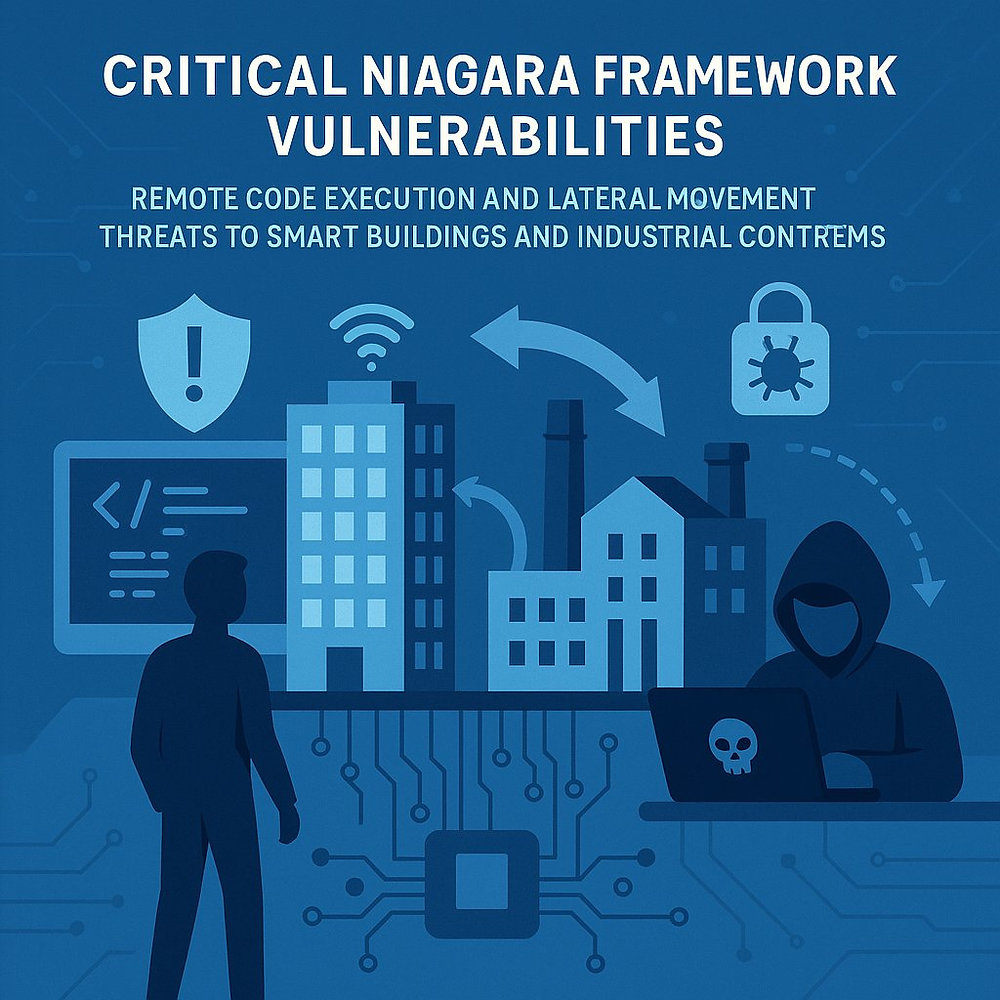
Recent findings have brought to light critical vulnerabilities within the Niagara Framework, a platform widely used in smart building automation and industrial control systems. These flaws not only enable remote code execution (RCE) but also allow for lateral movement across networks, posing severe risks to systems connected to key infrastructure. Threat actors, including advanced persistent threat (APT) groups such as APT28 and APT33, are actively exploiting these vulnerabilities in sectors ranging from government to energy and manufacturing.
"We are seeing these vulnerabilities utilized in real-world scenarios, targeting various critical infrastructures across regions including the USA, Germany, Poland, Iran, Saudi Arabia, and the UAE," said a cybersecurity analyst familiar with the findings. The importance of addressing these vulnerabilities cannot be overstated, given that they could lead to comprehensive system breaches and unauthorized access to sensitive data.
"We are seeing these vulnerabilities utilized in real-world scenarios, targeting various critical infrastructures across regions including the USA, Germany, Poland, Iran, Saudi Arabia, and the UAE,"


The technical weaknesses stem from a combination of privilege escalation techniques triggered by buffer overflow vulnerabilities. The crux of the issue lies in improperly validated user inputs that allow attackers to bypass authentication protocols, eventually leading to the execution of arbitrary code within smart building and industrial operational systems. "Attackers can craft specific inputs that exploit these conditions leading to unauthorized remote code execution, which is a serious breach," said the analyst.
"Attackers can craft specific inputs that exploit these conditions leading to unauthorized remote code execution, which is a serious breach,"

Once inside the system, threat actors often leverage established methodologies to maintain access and move laterally within networks, which typically connect information technology (IT) and operational technology (OT). "The exploitation techniques align with several MITRE ATT&CK vectors, notably T1203 for privilege escalation and T1021.001 for remote service exploits," the analyst explained.

Moreover, the vulnerabilities present in the Niagara Framework not only grant attackers the ability to commandeer targeted systems but also expose sensitive operational information that could be useful for conducting further attacks. "The way these vulnerabilities are structured demonstrates a significant oversight in coding that has not kept pace with modern security expectations," noted a cybersecurity researcher. This oversight reveals that the failure to implement adequate bounds checking on user inputs is a primary flaw, allowing adversaries to manipulate backend processes critical to operational integrity.
"The way these vulnerabilities are structured demonstrates a significant oversight in coding that has not kept pace with modern security expectations,"

Team Dynamics
Team Dynamics
Particularly concerning is the evidence from researchers who have demonstrated the existence of these flaws through authenticated proof-of-concept code. "Research from teams like SecuriTeam has provided detailed documentation that highlights how these vulnerabilities can be exploited to execute remote code and execute lateral movements across interconnected networks," said the cybersecurity expert. The existence of such vulnerabilities is not merely theoretical; they are actively exploited in the field, as evidenced by intelligence reports from recent investigations.
Team Dynamics
"Research from teams like SecuriTeam has provided detailed documentation that highlights how these vulnerabilities can be exploited to execute remote code and execute lateral movements across interconnected networks,"
Field intelligence reinforces the severity of the situation, with recent reports indicating these vulnerabilities are not confined to theoretical models or lab environments. "We’ve observed concrete instances of exploitation occurring in real settings," said a cybersecurity analyst.
"We’ve observed concrete instances of exploitation occurring in real settings,"
Given that the ramifications of a successful exploit can extend well beyond merely taking control of a single system, organizations using the Niagara Framework must prioritize understanding these vulnerabilities. As the analyst emphasized, "The long-term implications of these flaws could threaten the operational integrity of entire segments if left unaddressed."
In response to these findings, Rescana has committed to assisting clients through its advanced third-party risk management (TPRM) platform. "We aim to reinforce cybersecurity postures and provide support necessary for mitigating these risks effectively," said a Rescana executive. Immediate and comprehensive action is essential to mitigate the identified risks, and organizations are urged to adopt the recommended strategies as they confront these serious vulnerabilities.
"We aim to reinforce cybersecurity postures and provide support necessary for mitigating these risks effectively,"
As smart buildings and industrial control systems continue to be integrated into our urban infrastructure, the security of platforms like the Niagara Framework will be paramount. The ongoing threat from sophisticated adversaries demands vigilance and proactive measures from organizations to safeguard their critical assets.