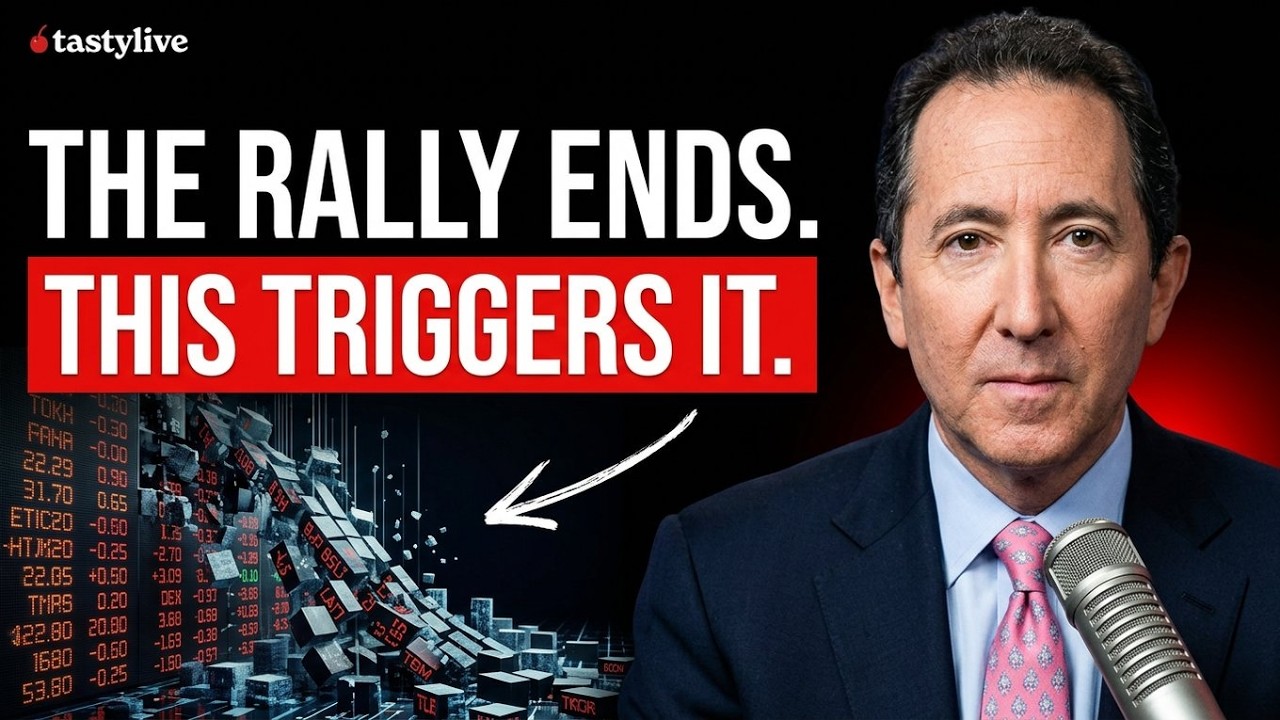
1BFG Wealth Partners chief investment officer Peter Boockvar has told tastylive that the global rate cycle is now being set by long-end bond investors rather than central banks, and that the relentless AI capex spend is driving a fracture in the Magnificent 7 that retail investors are not yet pricing in.
Asked by tastylive's head of global macro Julia Spivac why equity markets are still climbing while crude is at the top of its range, gold is bid and yields are sharply higher, Boockvar laid the resilience at the feet of two distinct trades: the AI infrastructure build, and an end-of-war rally that nobody wants to miss.
"It's the infrastructure builders, whether it's semis, power, HVAC, and so on, obviously doing very well, particularly the semis and the memory and storage names," Boockvar said. "Then you add in of course a little FOMO, performance chase and so on. But I would attribute the resiliency from those two things."
Beneath the surface, however, the rally is much narrower than the headline indices suggest. "If you look at the percent of stocks that are trading above its 200-day moving average, it's lagging," Boockvar said. "It really is just siloed to anything touching AI, particularly semis." Equal-weighted versions of the S&P 500 and Nasdaq, including the RSP and QQEW, are not showing the same enthusiasm.
The most pointed call from Boockvar concerned the Mag 7 itself. "The Mag 7 is splintering because there's a lot more of a microscope and scrutiny on the shrinking free cash flows of the spenders on AI, those being the hyperscalers, while they're benefiting the recipients of those that spend."
Boockvar argued the spend is not sustainable on either end. "Oracle is not going to stay in business if they continuously spend 75 per cent of the revenue on capex. Even Meta, as great a company as it is and with the robust cash flows that they generate, spending half their revenue on capex is not a sustainable thing. So this eventually does slow down. I have no idea when, but it does have ripple effects."
He warned the same hyperscaler dollars are running into permitting and supply-chain walls on the build side. "There are stories that maybe up to 40 per cent of the planned data centres that are expected to be constructed this year may get punted to 2027 or 2028 because of permitting reasons, not-in-my-backyard reasons and just supply-chain reasons."
The capex squeeze is then layered on top of a coming wave of mega-cap IPO supply that Boockvar credited to Paul Tudor Jones. "When you look at the market caps that are going to be put into the public markets with Anthropic, with SpaceX, with eventually OpenAI, the size of these market caps. SpaceX a trillion and a half, Anthropic 800, OpenAI call it another seven, eight hundred. So that's three trillion. That's probably a combined amount of all the IPOs we've seen for multiple years prior."
Boockvar's most consequential macro line, though, was on monetary policy itself. With the Reserve Bank of Australia having hiked to 4.35 per cent on Tuesday and the European Central Bank now expected to deliver 50 to 75 basis points of hikes this year despite earlier cuts, Boockvar argued the steering wheel has changed hands.
"Long-term interest rates are now running monetary policy. Central banks are not running it anymore," he said. "It is now in the hands of long-term bond investors. The RBA with that hike to 4.35 per cent has now fully taken back all of their cuts that began a year ago. And even with the rate cuts that we saw in Europe of 200 basis points in their deposit rate, you still have 15-year highs in long-term interest rates there."
The dollar story, in his view, is also no longer a one-way trade. The DXY has given back nearly all of its early-war spike, the Aussie dollar is near a four-year high, and the Brazilian real and Canadian dollar are holding firm. Boockvar called it 'a mega-secular trend' of capital and trade-flow diversification away from US assets that he expects to last for years.