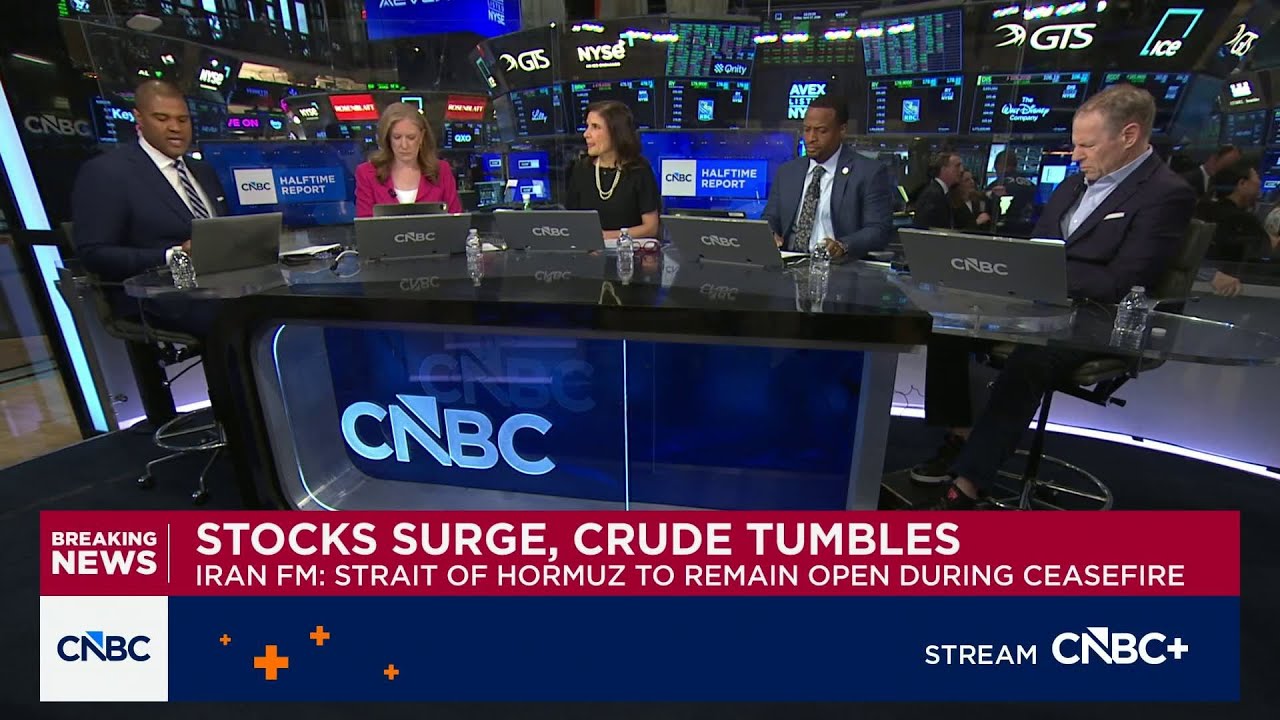
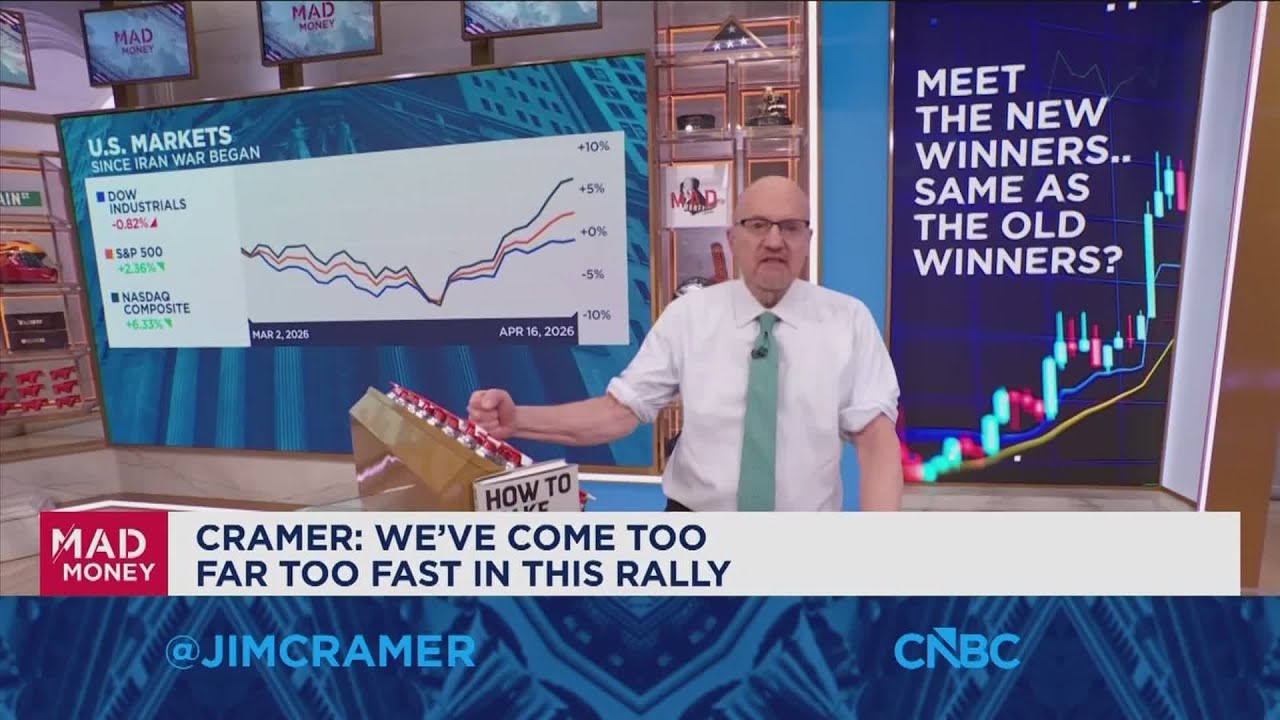
The Nasdaq Composite stretched its winning streak to 13 consecutive sessions this week, its best run in more than three decades, while the S&P 500 pushed past 7,150 and the Dow added more than 1,000 points in a single session. On CNBC's Halftime Report, the panel's mood was less celebration and more quiet nerves.
"It is cloudy out there and what what the market has priced in I think the best case scenario," said Jenny Harrington of Gilman Hill Asset Management, borrowing a children's book title to describe her outlook. "The outlook to me for the very short term is cloudy with a chance of meatballs where it's just cloudy out there and meatballs might start falling from the sky."
Harrington said the battle between short-term risk and long-term earnings power was the hardest position for investors to sit with. She flagged disruptions still working through global supply chains, including fertilizer flows to Asia at the start of the rice planting season, as examples of second-order effects the market has yet to stress-test. On a twelve-month view, though, she framed the fundamentals as intact: "In the longer term, you can really count on 16 plus percent earnings growth. I love the fact that the multiple actually contracted on the S&P by 10%, moving from 22 times down to 20 times during the quarter."

The move that unsettled her colleagues was not the direction but the speed. Jason Snipe of Odyssey Capital Advisors said the vertical rebound triggered his risk radar. "Too far, too fast is definitely a big deal for me as as we've seen to your point earlier, Frank, on 13 days in a row of the NASDAQ kind of running. highest numbers we've seen since the early 90s. Right? So, I think that is definitely room for concern for me."
Snipe also noted that the advance had been narrow, with the cap-weighted S&P dramatically outpacing the equal-weighted RSP, a split he said was "not healthy going forward."
Amy Raskin of Chevy Chase Trust urged a wider lens. "We started the year at 6,800 6900 so being at 7,150 does it you know if you just look at the two end points it hasn't been a huge rally and we were sort of around these levels last October so I think um I think we should just everybody just take a step back."
Steve Weiss of Short Hills Capital Partners delivered the bluntest read. Referencing a Barclays note on investor FOMO, he said the snap rally had broken every comfortable precedent. "In the last 40 years, you've seen the quickest move from being oversold to being overbought. So, typically when that happens, there is a pullback."
Weiss said he was not selling, but was keeping dry powder. "I'm not betting on it. I'm not adjusting my positioning, but should be aware of it. And why I am conscious of it is because I still have some cash. Not a lot, but I'd use that opportunity to buy in this market."
His warning on the information environment was sharper still. "It's not a mark any of us have ever seen. It makes no sense. It's too easy. When marks are too easy, that's when trouble starts brewing. And you can't believe the headlines. You can't believe anything coming out of headlines because there's one narrative coming from Washington. There's another narrative coming from Iran. You can't believe either one of them."
The conflicting narratives Weiss referenced played out in real time during the segment. CNBC's Megan Cassella reported that President Trump had been telling reporters a deal with Iran was "almost done," claiming Tehran had agreed to indefinitely suspend its nuclear program and forgo access to frozen funds. Iranian state media disputed US statements about the Strait of Hormuz, saying that as long as a US naval blockade remained in place, the strait would not be considered reopened.
WTI crude was down roughly 12% on the session to around $83 a barrel as the headlines shifted.